#1
Best OverallMapleFX Canada
4.9
- Min. Deposit
- $100 CAD
- Spread from
- 0.6 pips
- Platform
- MT4 / MT5
- Regulation
- CIRO • CIPF
- Lowest USD/CAD spreads
- CAD base accounts
- Fast e-Transfer deposits
Compare the best CIRO-regulated forex brokers in Canada, learn how to trade currency pairs like USD/CAD, and start your forex trading journey with confidence. Independent reviews, real spreads, and beginner-friendly guides built for Canadian traders.
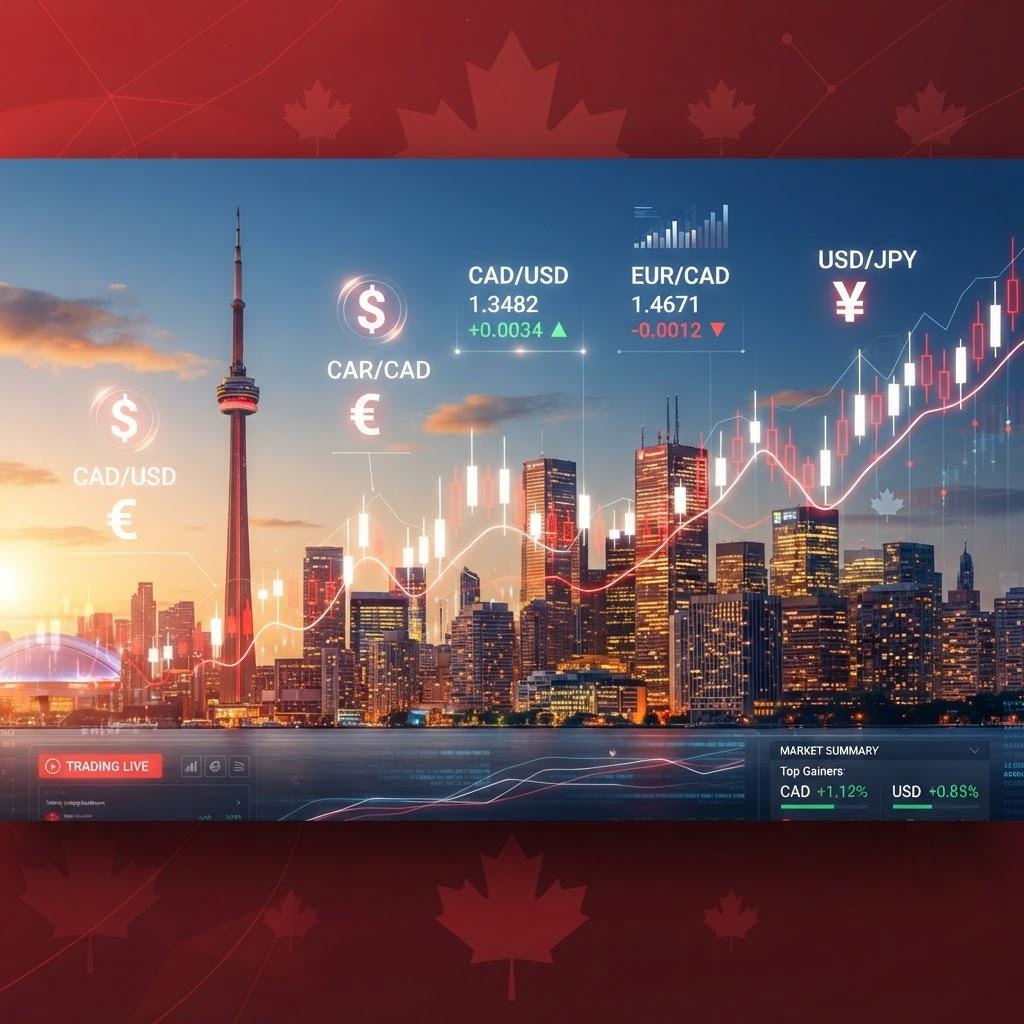
Every broker below is regulated by the Canadian Investment Regulatory Organization (CIRO) and offers CIPF investor protection. Rankings are based on spreads, platform quality, funding options, and Canadian trader support.
Disclaimer: Forex Trading Canada may earn an affiliate commission when you open an account through links on this page, at no extra cost to you. Trading forex carries a high level of risk and may not be suitable for all investors. Always trade responsibly.
Forex trading in Canada has grown from a niche activity into one of the most popular ways for Canadians to participate in the global financial markets. Every single day, more than seven trillion US dollars changes hands across the foreign exchange market, and a growing share of that activity comes from Canadian retail traders in Toronto, Vancouver, Calgary, Montreal, and across every province and territory. Whether you want to trade the Canadian dollar against the US dollar, speculate on major currency pairs, or simply understand how the currency market works, this guide gives you everything you need to start forex trading in Canada the right way.
At Forex Trading Canada, our mission is simple: to help Canadian traders find safe, regulated forex brokers and to learn the skills required to trade currencies responsibly. In this in-depth guide we cover what forex trading is, how it is regulated in Canada, how to choose the best Canadian forex broker, the trading platforms you will use, the most important forex terms and definitions, proven strategies, risk management, taxes, and answers to the questions Canadian traders ask most. By the end, you will know exactly how to open an account and place your first trade with confidence.
Forex, short for foreign exchange, is the global marketplace where national currencies are bought and sold against one another. It is the largest and most liquid financial market in the world, operating 24 hours a day, five days a week, with no single central exchange.
Forex trading is the act of buying one currency while simultaneously selling another, always in pairs. When you trade forex, you are speculating on whether one currency will strengthen or weaken relative to another. For example, if you believe the Canadian dollar will strengthen against the US dollar, you would sell the USD/CAD pair. Because currencies are always quoted in pairs, every forex trade involves two currencies at once: the base currency and the quote currency.
A currency pair is the quotation of two different currencies, where the value of one currency is quoted against the other. The first currency is the base currency and the second is the quote currency. In USD/CAD, the US dollar is the base and the Canadian dollar is the quote.
Unlike the Toronto Stock Exchange, the forex market has no central physical location. Instead, currency trading happens electronically over the counter (OTC) through a global network of banks, brokers, and liquidity providers. This decentralized structure is why the market can operate around the clock across major sessions in Sydney, Tokyo, London, and New York. For Canadian traders, the London and New York sessions typically offer the most liquidity and the tightest spreads, especially for pairs involving the Canadian dollar.
When you place a trade with a Canadian forex broker, the broker connects your order to the interbank market or fills it internally. You never take physical delivery of the currency; instead, you profit or lose based on the change in the exchange rate between the two currencies in your chosen pair. Most retail forex trading in Canada is done using leverage, which allows you to control a larger position with a smaller amount of capital.
Leverage lets a trader control a large position with a relatively small deposit, expressed as a ratio such as 30:1. While leverage can amplify profits, it equally amplifies losses, which is why Canadian regulators cap the leverage that brokers can offer retail clients.
Yes. Forex trading is completely legal in Canada, and it is well regulated to protect retail traders. The key is to trade only with a broker that is authorized to operate in Canada. Forex and contract-for-difference (CFD) brokers that serve Canadian residents must be registered with the Canadian Investment Regulatory Organization (CIRO), the national self-regulatory body that oversees investment dealers and trading activity. CIRO was formed from the merger of the former IIROC (Investment Industry Regulatory Organization of Canada) and the MFDA.
The Canadian Investment Regulatory Organization (CIRO) is the national self-regulatory organization that oversees all investment dealers, mutual fund dealers, and market activity in Canada. Any legitimate forex broker serving Canadian clients should be a CIRO member.
In addition to CIRO, forex trading in Canada is overseen at the provincial level by securities commissions that are coordinated through the Canadian Securities Administrators (CSA). These include the Ontario Securities Commission (OSC), the British Columbia Securities Commission (BCSC), the Alberta Securities Commission (ASC), and the Autorite des marches financiers (AMF) in Quebec. Together with CIRO, these bodies enforce the rules that keep Canadian forex traders safe from fraud and unfair practices.
The Canadian Investor Protection Fund (CIPF) protects eligible client assets, up to defined limits, if a CIRO-member firm becomes insolvent. Trading only with CIPF-covered brokers adds an important layer of protection for Canadian traders.
To protect retail clients, CIRO limits the amount of leverage that forex brokers can offer in Canada. Major currency pairs such as USD/CAD, EUR/USD, and GBP/USD are typically capped around 30:1 to 50:1 for retail traders, while more volatile minor and exotic pairs carry lower limits. These caps are lower than the extreme leverage offered by some offshore brokers, but they exist specifically to reduce the risk of catastrophic losses. Professional and institutional clients may qualify for higher leverage.
Choosing the right broker is the single most important decision you will make as a Canadian forex trader. The best forex brokers in Canada combine strong regulation, competitive pricing, reliable platforms, and local support. Here are the key factors to compare before you open an account.
Always confirm that a broker is a CIRO member and offers CIPF protection before depositing any funds. A properly regulated Canadian forex broker is required to keep client money in segregated accounts, follow strict capital requirements, and provide transparent pricing. If a broker is not registered to operate in Canada, avoid it, no matter how attractive the promotions appear.
Trading costs directly affect your bottom line. Look for tight spreads on the pairs you plan to trade, especially USD/CAD if you trade the Canadian dollar. Some brokers offer commission-free accounts with slightly wider spreads, while others charge a small commission with raw, near-zero spreads. Also check for overnight financing (swap) charges, deposit and withdrawal fees, and inactivity fees.
The spread is the difference between the bid (sell) price and the ask (buy) price of a currency pair. Measured in pips, it is the primary cost of entering a forex trade and a key way brokers earn revenue.
A good Canadian forex broker will let you open a CAD-denominated account so you avoid unnecessary currency conversion fees. Look for convenient local funding methods such as Interac e-Transfer, bank wire, and major credit and debit cards. Fast, low-cost deposits and withdrawals in Canadian dollars make a real difference to your overall trading experience.
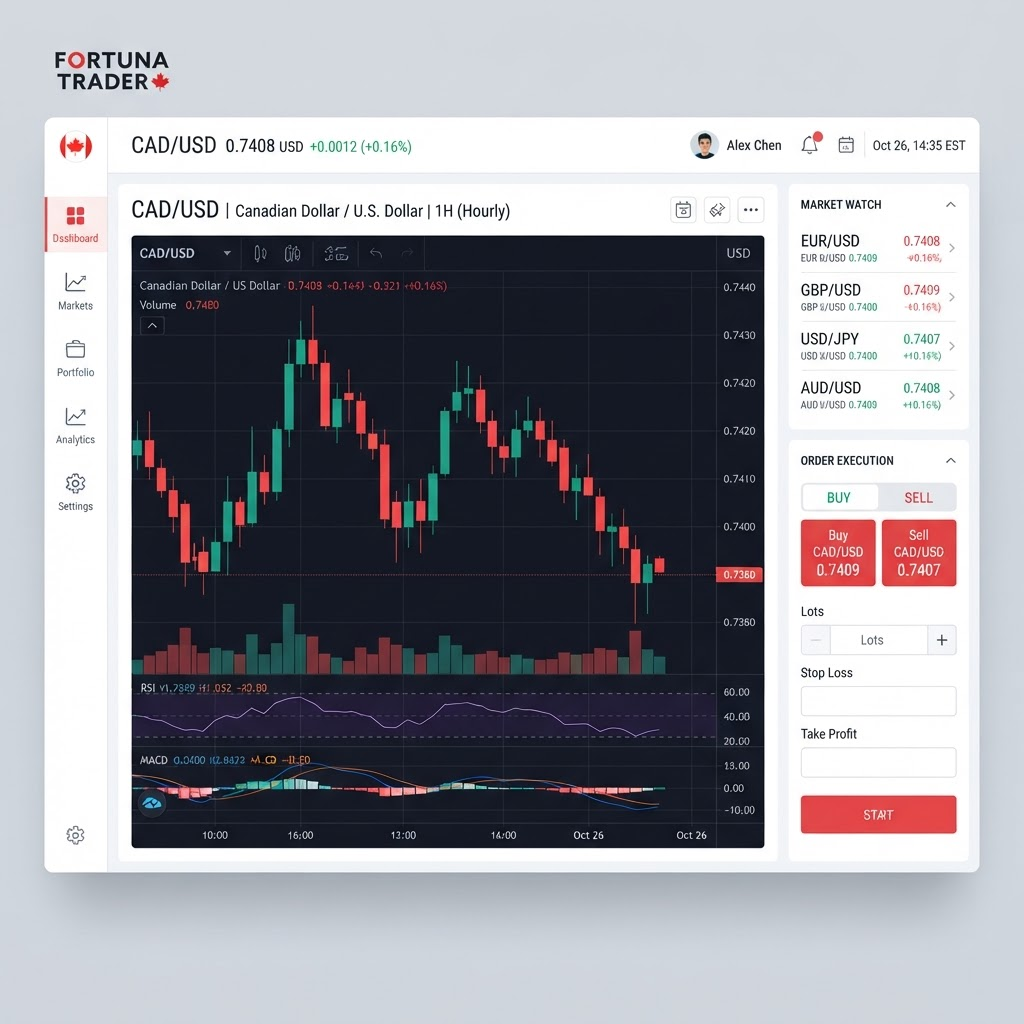
The trading platform is where you will spend most of your time, so it needs to be fast, stable, and easy to use. The most popular platforms among Canadian traders are MetaTrader 4 (MT4), MetaTrader 5 (MT5), and cTrader, along with proprietary web and mobile apps. Look for advanced charting, technical indicators, automated trading support, and a reliable mobile app so you can manage trades on the go.
The right platform can make trading smoother and more efficient. Below are the platforms most Canadian forex brokers offer, and what each one is best suited for.
MetaTrader 4 remains the most widely used forex trading platform in the world. It is popular with Canadian traders for its simplicity, powerful charting, and huge library of custom indicators and expert advisors (EAs) that allow automated trading. If you are a beginner focused purely on forex, MT4 is a safe and proven choice.
MetaTrader 5 is the more modern successor to MT4. It supports more asset classes, additional timeframes, an economic calendar, and faster execution. Canadian traders who want to trade forex alongside indices, commodities, or stocks often prefer MT5.
cTrader is favoured by more advanced traders for its clean interface, level II pricing, and ECN-style execution. Many brokers also offer browser-based web platforms and polished mobile apps, so you can trade from any device without installing software.
Currency pairs are grouped into three categories: majors, minors, and exotics. Understanding these groups helps you pick the right pairs for your strategy and risk tolerance.
Major pairs always include the US dollar and are the most heavily traded, offering the tightest spreads and deepest liquidity. Examples include EUR/USD, GBP/USD, USD/JPY, and USD/CAD. For Canadian traders, USD/CAD, nicknamed the loonie, is often the pair of choice because it is closely tied to the domestic economy and oil prices.
Minor pairs, also called crosses, do not include the US dollar. Examples include EUR/GBP, EUR/CAD, and GBP/JPY. They can offer trading opportunities but usually come with slightly wider spreads than the majors.
Exotic pairs combine a major currency with the currency of a smaller or emerging economy, such as USD/MXN or USD/ZAR. These pairs can be volatile, carry wider spreads, and are best left to experienced traders.
A pip (percentage in point) is the smallest standard price move in a currency pair, usually the fourth decimal place (0.0001). Pips are how traders measure gains, losses, and spreads.
Getting started with forex trading in Canada is straightforward when you follow a clear, disciplined process. Here is the exact sequence we recommend for new Canadian traders.
A demo account is a practice trading account funded with virtual money. It lets Canadian beginners learn a platform and test strategies in live market conditions without any financial risk.
There is no single best forex strategy; the right approach depends on your personality, schedule, and risk tolerance. Below are the most common trading styles used by Canadian traders.
Day traders open and close positions within the same trading day to capture short-term price movements. This style suits people who can watch the markets during the active London and New York sessions and who enjoy fast decision-making.
Swing traders hold positions for several days to weeks, aiming to profit from medium-term trends. It requires less screen time than day trading, making it popular with Canadians who trade around a full-time job.
Scalping involves placing many small trades to capture tiny price movements throughout the day. It demands tight spreads, fast execution, and intense focus, so it is generally recommended only for experienced traders.
Position traders take a long-term view, holding trades for weeks or months based on fundamental analysis and major economic trends. This patient style relies on interest rates, economic data, and central bank policy from institutions such as the Bank of Canada.
Successful forex trading is far more about managing risk than about predicting the market. The majority of retail traders who lose money do so because of poor risk control, not a lack of good trade ideas. Protecting your capital is the foundation of long-term success.
A stop-loss is an order that automatically closes a trade once the price reaches a set level, capping the loss on that position. It is one of the most important risk-management tools available to forex traders.
Profits from forex trading in Canada are taxable, and how they are taxed depends on whether the Canada Revenue Agency (CRA) treats your activity as capital gains or as business income. Occasional traders may report gains as capital gains, of which only a portion is taxable, while frequent, active traders may have their profits treated as fully taxable business income.
Because tax treatment depends on your individual circumstances, it is wise to keep detailed records of every trade and to consult a qualified Canadian accountant or tax professional. This guide is educational and does not constitute tax advice. Proper record keeping from day one will save you significant stress at tax time.
Learning from the mistakes of others is one of the fastest ways to improve. Here are the pitfalls that trip up most beginner forex traders in Canada.
Margin is the amount of money required in your account to open and maintain a leveraged position. If your losses erode your available margin too far, your broker may issue a margin call and close positions automatically.
A quick-reference glossary of the essential forex terms every Canadian trader should know.
Answers to the most common questions about forex trading in Canada.
Yes, forex trading is completely legal in Canada. To trade safely, you should use a broker regulated by the Canadian Investment Regulatory Organization (CIRO) that offers Canadian Investor Protection Fund (CIPF) coverage.
Many Canadian forex brokers let you open an account with as little as $100 CAD. However, most experts recommend starting with an amount you can comfortably afford to lose and practising on a free demo account first.
The best forex broker depends on your needs, but the top Canadian brokers all share strong CIRO regulation, CIPF protection, tight spreads, CAD funding options, and reliable platforms like MetaTrader 4 and MetaTrader 5. See our comparison above.
Yes. Depending on how you trade, the Canada Revenue Agency may treat your forex profits as capital gains or as business income. Keep detailed records and consult a Canadian tax professional for advice specific to your situation.
CIRO limits leverage to protect retail traders. Major pairs such as USD/CAD are typically capped around 30:1 to 50:1, with lower limits on more volatile pairs. Offshore brokers may offer higher leverage but lack Canadian regulatory protection.
Absolutely. Beginners should start by learning the basics, opening a demo account, choosing a CIRO-regulated broker, and trading small with strict risk management. Forex trading takes practice, so patience and education are key.
USD/CAD, nicknamed the loonie, is a favourite among Canadian traders because it is highly liquid, offers tight spreads, and is closely tied to the Canadian economy and oil prices. EUR/USD is also popular worldwide.
It is not mandatory, but a CAD-denominated account helps you avoid unnecessary currency conversion fees when depositing and withdrawing. Most leading Canadian forex brokers offer CAD base accounts.
Forex trading in Canada offers real opportunity for those who take the time to learn the market, choose a properly regulated broker, and trade with discipline. The foreign exchange market is open around the clock, deeply liquid, and accessible to Canadians of every experience level. But opportunity always comes with risk, and the traders who succeed over the long term are the ones who prioritize education and risk management above quick profits.
Begin by mastering the fundamentals covered in this guide, from currency pairs and pips to leverage and stop-losses. Then select a CIRO-regulated, CIPF-protected broker from our comparison, practise on a demo account, and start small with a clear trading plan. With patience, consistent risk management, and continuous learning, you can trade the currency markets with confidence from anywhere in Canada.
Forex Trading Canada is here to guide you every step of the way. Compare the best Canadian forex brokers, deepen your knowledge with our guides, and take your first step toward becoming a confident, responsible forex trader.